
Camera Austria International
83 | 2003
- REINHARD BRAUN
Klaus Schuster: Ambiguous Images - KLAUS SCHUSTER
- HERWIG HÖLLER
Aleksandr Ilich Lyashenko known as Petlyura - PANI BRONJA UND ALEKSANDR PETLJURA
- KIM CASCONE
Derek Holzer & Bas van Koolwijk: System as a Signal, Data as Fluid, Behavior as Structure - DEREK HOLZER & BAS VAN KOOLWIJK
- CHRISTA BLÜMLINGER
Chris Marker, an Archaelogist of the Imaginary - CHRIS MARKER
- ANNETT BUSCH
Frieda Grafe - FRIEDA GRAFE

Preface
In the form of monographic contributions, Camera Austria No. 83 focuses on a series of very individual positions which, as so often, transcend the notion of photography in the narrower sense, extending the concept of the image to encompass media, film and performance: The Austrian artist Klaus Schuster has been specifically exploring the artificiality of images since the mid-nineties. His digitally constructed photographs and video works appear to be “ambiguous images” between hypothesis and reality. In his contribution, Reinhard Braun presents Schuster’s current series entitled “Selbstorganisation” (Self-organisation) which, like his previous works, deal in depth with “the constantly changing association between the object portrayed, the technique and contextual knowledge”, reflecting above all on the process of image creation itself.
Entries
-
Klaus Schuster: Ambiguous Images
Klaus Schuster’s “Locations” seem like alien stills taken from this mass media image machine of the imaginary, like the animated loops of his video works seem to embroil us in a repetitive suggestion of fragments of moving images from this strange universe of technical images. With the one difference that they do not even try to conceal their constructedness and artificiality.
This artificiality, offensively displayed, applies even more so to the series of current works compiled by Klaus Schuster under the heading “Selbstorganisation” (Self-organisation), although the question remains whether this concept refers to a “life-model” of the artist, to socio-cultural processes in general or, as it were, describes the image construction from the perspective of the images themselves, as if they came from an undefined “beyond” of digital apparatuses, as if they at first represented their imaginary aspects. The openness of the title, however, points to the pressing question of a contemporary pictoriality and its precarious, borderline status in the framework of dissipating discourses on realities – especially as photography in particular (and the works clearly do seem to simulate photography) is constituted as a medium and discourse formation by an overlapping of technology (a technicity of culture as a whole), knowledge and art. The “signature of images”, as Philippe Dubois put it, thus no longer refers primarily to something pre-existing, but rather to processual aspects of image creation itself, which corresponds to a general transition from seeing to visualisation. With the “Self-organisation” series, we are in the middle of an enactment of the world as a process inherent in the image and, at the same time, inherent in technology: images of a world that no longer need this world.Text feature in Camera Austria International 83/2003, pp. 7–18.
-
-
KLAUS SCHUSTER

Künstlerbeitrag / Artist feature in Camera Austria International 83/2003, S. / pp. 7–18.
Klaus Schuster, still aus / from: Veranda, 1999. Video Loop, 6 sec. -
KLAUS SCHUSTER

Künstlerbeitrag / Artist feature in Camera Austria International 83/2003, S. / pp. 7–18.
Klaus Schuster, still aus / from: Veranda, 1999. Video Loop, 6 sec. -
KLAUS SCHUSTER

Künstlerbeitrag / Artist feature in Camera Austria International 83/2003, S. / pp. 7–18.
Klaus Schuster, Megaphon, 2003. -
KLAUS SCHUSTER

Künstlerbeitrag / Artist feature in Camera Austria International 83/2003, S. / pp. 7–18.
Doppelseite / spread: Klaus Schuster, S. / pp. 16–17. -
KLAUS SCHUSTER

Künstlerbeitrag / Artist feature in Camera Austria International 83/2003, S. / pp. 7–18.
Klaus Schuster, Dampfbad, 2003. -
KLAUS SCHUSTER

Künstlerbeitrag / Artist feature in Camera Austria International 83/2003, S. / pp. 7–18.
Klaus Schuster, Fell, 2003.
-
-
Aleksandr Ilich Lyashenko known as Petlyura
In Moscow at least, Aleksandr Ilich Lyashenko, otherwise known as Petlyura, was for many years an underrated and controversial member of the movement known as “current Moscow art”. Underrated, because Moscow art criticism, fixated as it is on particular discourses, abounds in blind spots, and because important critics only began to deal with contemporary art in the form of “Moscow conceptualism” and / or “Moscow radicalism” around 1990, with the result that many precursors, including Petlyura’s actionism of the late eighties, continued to be ignored. Controversial because the works themselves, at the frontier of the fine and dramatic arts, were considered by the most progressive elements of the contemporary art scene, virtually throughout the nineties, to be a social phenomenon rather than serious, i.e. discursive art. The daily newspaper Kommersant daily, the leading journalistic organ of the nineties, went so far as to dub Petlyura in 1993 “one of the most mysterious and pointless figures in the artistic life of the city”.
Lyashenko was born in 1955 in the Russian-speaking part of Eastern Ukraine, a region in which, as he likes to stress, “freedom-loving” peoples lived and which produced freedom fighters of the stature of Nestor Makhno and Simon Petlyura, who in the 1920s fiercely resisted the Bolsheviks. But the artist himself also put up some resistance from an early age, for example against the school curriculum which demanded the study of the literary outpourings of Leonid Brezhnev, as a result of which he was thrown out of the Kharkov Art School after his first year. After this he moved to Moscow, where he took up his artistic studies again in 1981 at the Moscow Stroganov Institute, specializing in interior design. “At that time the Stroganov Institute was the only institution in Moscow”, relates Lyashenko, “at which contemporary artistic disciplines such as design were taught at all and I was determined to learn the language of contemporary art.” “Non-standard approaches” force him to interrupt his studies three times, which he finally completes in 1988.Text feature in Camera Austria International 83/2003, pp. 19–30.
-
-
PANI BRONJA UND ALEKSANDR PETLJURA

Künstlerbeitrag / Artist feature in Camera Austria International 83/2003, S. / pp. 19–30.
Proben des Kollektivs, 1991. Photo: Aleksandr Petljura. -
PANI BRONJA UND ALEKSANDR PETLJURA

Künstlerbeitrag / Artist feature in Camera Austria International 83/2003, S. / pp. 19–30.
Aleksandr Petljura, Sonnenblumen, aus der Serie / from the series: 25 Jahre später. Das Imperium in Dingen. 200 - 2001.
Photo: Vita Bujvid. -
PANI BRONJA UND ALEKSANDR PETLJURA
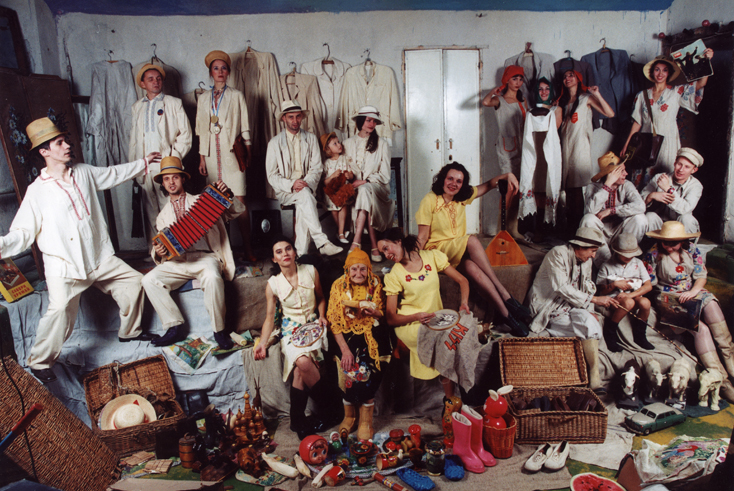
Künstlerbeitrag / Artist feature in Camera Austria International 83/2003, S. / pp. 19–30.
Aleksandr Petljura, Kornfeld, aus der Serie: 25 Jahre später. Das Imperium in Dingen. 200 - 2001.
Photo: Vita Bujvid. -
PANI BRONJA UND ALEKSANDR PETLJURA

Künstlerbeitrag / Artist feature in Camera Austria International 83/2003, S. / pp. 19–30.
Doppelseite / spread: Aleksandr Petljura, S. / pp. 24–25. -
PANI BRONJA UND ALEKSANDR PETLJURA

Künstlerbeitrag / Artist feature in Camera Austria International 83/2003, S. / pp. 19–30.
Aleksandr Petljura, Ich gehe zur Sonne, 1996.
Photo: Heidi Hollinger.
-
-
Derek Holzer & Bas van Koolwijk: System as a Signal, Data as Fluid, Behavior as Structure
DATA AS FLUID
“We can create an audio file made up of tiny sonic grains mimicking the behavior of flocking starlings, moving through the listeners three-dimensional soundspace using the wobbly orbit of Neptune and then send the audio data through a waveshaping transfer function resembling this months stock exchange. Numbers are fuel in the engine of the central processing unit …”
When using computers to store and manipulate sound, we must first convert the analog signal into a digital one“ the audio signal is converted into discrete numerical values. The signal sheds its physical properties and transforms into a rough-hewn abstraction“ a jagged shadow of the analog signal. Once in binary form, data assumes a fluidic state, able to flow through the boundaries of data-types, file-types and the inputs and outputs of algorithms. The direct playback of numerical values is referred to as “0th-order sonification”. Data is simply poured through a digital to analog converter and out to a set of speakers. Sound artists often use this technique as another form of processing, allowing them unlimited ways to view, shape or reorganize data. In other words, by sending an array of numbers through a boundary, one can change the “meaning” of data. For example, take a graphic file of a sunflower and pour it into a sound file it then becomes harsh digital noise and ceases to convey the meaning of a flower. Another example: by converting a sound-file into a QuickTime movie with audio software such as Soundhack, one can transform Lou Reed’s “Metal Machine Music” into an abstract piece of electronic cinema. Data is a numerical fluid that can be poured into any container and assume new meaning; it is the Prima Materia with which a digital artist shapes and molds his art.Text feature in Camera Austria International 83/2003, pp. 32–37.
-
-
DEREK HOLZER & BAS VAN KOOLWIJK

Künstlerbeitrag / Artist feature in Camera Austria International 83/2003, S. / pp. 32–37.
Derek Holzer & Bas van Koolwijk, still aus / from: Performance, Earational Festival, Den Bosch (NL), 6. April 2003. -
DEREK HOLZER & BAS VAN KOOLWIJK

Künstlerbeitrag / Artist feature in Camera Austria International 83/2003, S. / pp. 32–37.
Derek Holzer & Bas van Koolwijk, still aus / from: Performance, Earational Festival, Den Bosch (NL), 6. April 2003. -
DEREK HOLZER & BAS VAN KOOLWIJK

Künstlerbeitrag / Artist feature in Camera Austria International 83/2003, S. / pp. 32–37.
Derek Holzer & Bas van Koolwijk, still aus / from: Performance, Earational Festival, Den Bosch (NL), 6. April 2003. -
DEREK HOLZER & BAS VAN KOOLWIJK

Künstlerbeitrag / Artist feature in Camera Austria International 83/2003, S. / pp. 32–37.
Derek Holzer & Bas van Koolwijk, still aus / from: Performance, Earational Festival, Den Bosch (NL), 6. April 2003. -
DEREK HOLZER & BAS VAN KOOLWIJK

Künstlerbeitrag / Artist feature in Camera Austria International 83/2003, S. / pp. 32–37.
Doppelseite / spread: Derek Holzer & Bas van Koolwijk, S. / pp. 34–35. -
DEREK HOLZER & BAS VAN KOOLWIJK

Künstlerbeitrag / Artist feature in Camera Austria International 83/2003, S. / pp. 32–37.
Derek Holzer & Bas van Koolwijk, Performance, Earational Festival, Den Bosch (NL), 6. April 2003.
Photo: Earational Festival.
-
-
Chris Marker, an Archaelogist of the Imaginary
To characterize Marker as a filmmaker would be to undersell him. He is a traveller, writer, essayist, photographer, a witness to historical events, storyteller, artist and much more“ and often all at the same time. In the light of certain fundamental points of reference, Bernhard Eisenschitz has characterized his closely-guarded (non-)biography as follows: resistance and liberation (wherever that may have been), the organization Peuple et Culture, in which André Bazin was also active, the journal Esprit, folk theatre. One could perhaps add the cinema“ in the early years of Cahiers du Cinéma, under the aegis of André Bazin, Marker wrote a series of reviews, already from faraway places: Germany, Mexico and Hollywood. A contemporary of the Nouvelle Vague but with a radically different background, in his work more akin to Resnais, Varda, Rouch and Gatti. Marker’s interest in literature and film first made its mark in his writing“ not least in a book about Giraudoux. His cultural predilections later surface again and again in his cinematic essays and are crystallized in “Immemory”, be it Hitchcock, Chateaubriand, Tarkovsky, Rilke or Michaux, just as his portraits of cats and the faces of women reappear repeatedly. He met Kurosawa and Medvedkin personally and dedicated entire films to them, however with Marker the filming of “Ran” in “A.K.” and the story of the film trains (“Le tombeau d’Alexandre”) are not simply records of having been there or straightforward stories, rather they are attempts, rich in association, to understand a way of working, a life, a world. From the outset Marker’s observations demonstrate a distance to what is being filmed in order to establish a discourse on history.
Text feature in Camera Austria International 83/2003, pp. 38–44.
-
-
CHRIS MARKER

Künstlerbeitrag / Artist feature in Camera Austria International 83/2003, S. / pp. 38–44.
Doppelseite / spread: Chris Marker, S. / pp. 38–39. -
CHRIS MARKER

Künstlerbeitrag / Artist feature in Camera Austria International 83/2003, S. / pp. 38–44.
Chris Marker, still aus / from: Sans Soleil, 1982. DVD 2003. -
CHRIS MARKER

Künstlerbeitrag / Artist feature in Camera Austria International 83/2003, S. / pp. 38–44.
Chris Marker, still aus / from: La Jetée, 1962. DVD 2003. -
CHRIS MARKER

Künstlerbeitrag / Artist feature in Camera Austria International 83/2003, S. / pp. 38–44.
Chris Marker, still aus / from: La Jetée, 1962. DVD 2003. -
CHRIS MARKER

Künstlerbeitrag / Artist feature in Camera Austria International 83/2003, S. / pp. 38–44.
Chris Marker, still aus / from: La Jetée, 1962. DVD 2003.
-
-
Frieda Grafe
We see Frieda Grafe in her dressing gown sitting at table, bent over paper and books. In the oven door next to her we see reflected a room, the kitchen, film theory alongside cookery books on the shelf. Frieda Grafe’s mobile office, she took cooking as seriously as writing. The image said, colon. “My bedroom is my study and my kitchen is my boudoir”. (“Boudoir” to be pronounced as by Bogart in “The Big Sleep”.) In truth, Frieda wrote poetry at the kitchen table, her desk was in her ‘boudoir’, which I also used as a place to sleep, the bedroom was really a pantry.” To leave the accustomed place. To scrutinise the blind spots of habit. When others said “of course”, she asked for details. Kracauer fared no better than Adorno. Ouija. “For me language is my stock-in-trade, so very general and mute that all my efforts, instead of greater generality, are aimed at making the wall of generality so thin that something can break through from beyond the barrier, from my body, into the so thoroughly articulated space of language. To demonstrate the generative foundation of language before is solidifies in a communicable form.”
Frieda Grafe’s language throve on visual aspects, moving pictures. To write about Frieda Grafe means to write about images and films she translated.Text feature in Camera Austria International 83/2003, pp. 45–49.
-
-
FRIEDA GRAFE

Künstlerbeitrag / Artist feature in Camera Austria International 83/2003, S. / pp. 45–49.
Frieda Grafe, 1995 ("My bedroom is my study and my kitchen is my boudoir").
Photo: Igor Patalas. -
FRIEDA GRAFE

Künstlerbeitrag / Artist feature in Camera Austria International 83/2003, S. / pp. 45–49.
Frieda Grafe, Süddeutsche Zeitung, 3./4. September 1977. -
FRIEDA GRAFE

Künstlerbeitrag / Artist feature in Camera Austria International 83/2003, S. / pp. 45–49.
Frieda Grafe, Süddeutsche Zeitung, 25./26. Februar 1978. -
FRIEDA GRAFE

Künstlerbeitrag / Artist feature in Camera Austria International 83/2003, S. / pp. 45–49.
Frieda Grafe, Süddeutsche Zeitung, 20./21. August 1988. -
FRIEDA GRAFE

Künstlerbeitrag / Artist feature in Camera Austria International 83/2003, S. / pp. 45–49.
Frieda Grafe, Süddeutsche Zeitung, 8./9. April 1972. -
FRIEDA GRAFE

Künstlerbeitrag / Artist feature in Camera Austria International 83/2003, S. / pp. 45–49.
Doppelseite / spread: Frieda Grafe, S. / pp. 48–49.
-
Forum
PATRICK O´HARE
JOHN GANIS
HIROSHI ONO
ANDREA WITZMANN
ANDREONI_FORTUGNO
STEFAN KORTE
UROŠ ĐJURIĆ
DAFNA TALMOR
MIRJANA RUKAVINA
SONJA GANGL
Exhibitions
La Biennale di Venezia. 50th International Exhibition of Art
Venedig
DENISE ROBINSON
La Mirada. Looking at Photography in Latin America Today
Daros Exhibitions, Zürich
SEBASTIAN LOPEZ
Wolfgang Tillmans, if one thing matters, everything matters
Tate Britain, London
JOHN SLYCE
Art Brewer
Earl McGrath Gallery, New York
CARLO MCCORMICK
Looking Glass Lens, Dreaming in Pictures: The Photography of Lewis Carroll. International Center of Photography, New York
RACHEL BAUM
Cruel and Tender, The Real in the Twentieth-century Photograph
Tate Modern, London; Museum Ludwig, Köln
JOHN SLYCE
Allan Sekula: Performance under Working Conditions
Generali Foundation, Wien
RUTH NOACK
Brassaï, Surrealist aus Gelegenheit, Modernist aus Passion
Albertina Wien
MARIE RÖBL
Marcel Broodthaers: Texte et Photos
Die Photographische Sammlung / SK Stiftung Kultur, Köln
CLAIRE ZIMMER
(Des)Organisation? Formen der Organisation
Galerie der Hochschule für Grafik und Buchkunst, Leipzig; Kunstraum der Universität Lüneburg
RAIMAR STANGE
Nothing Escapes Me, Louise Bourgeois: Intime Abstraktionen
Akademie der Künste, Berlin
REINHILD FELDHAUS
Territories
KW-Institute for Contemporary Art, Berlin
SØNKE GAU
Books
Aurel Hrabušický / Vàclav Macek: Slovenská Fotografia / Slovak Photography 1925 – 2000
Slovenská Národna Galéria, Bratislava, 2001
VALDIMIR BIRGUS
Kodachrome
Twin Palms Publishers, Santa Fe; Delano Greendige Editions, New York
SALLY STEIN
Evergreens à Gogo, Henk Tas: Why me Lord
TDS Drukwerken, Rotterdam, 2001
CAROLIN FÖRSTER
Aglaia Konrad: Elasticity
NAi Publishers, Rotterdam, 2002
JAN VERWOERT
Paolo Morello: Alfredo Camisa. Carteggio 1955 – 1963
Istituto Superiore per la Storia della Fotografia, Palermo, 2003
ROLF SACHSSE
Die moralischen Erzählungen der Susan Sontag. Susan Sontag: Das Leiden anderer betrachten
Carl Hanser Verlag, München, 2003
HERTA WOLF
Imprint
Publisher: Manfred Willmann. Owner: Verein CAMERA AUSTRIA, Labor für Fotografie und Theorie
All: Sparkassenplatz 2, A-8010 Graz
Editors: Christine Frisinghelli, Maren Lübbke, Manisha Jothady
Editorial assistants: Nora Theiss. Trainees: Kanako Nasu, Margareta Oliwa
Translations: Martin Brady, Wilfried Prantner, Richard Watts