
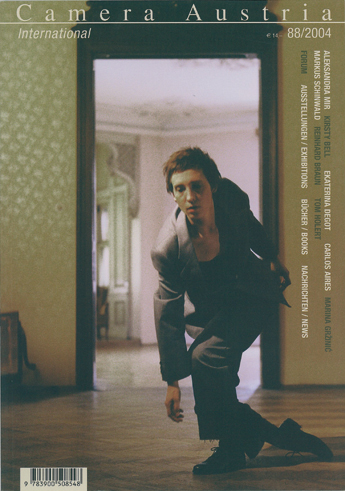
Camera Austria International
88 | 2004
- KIRSTY BELL
Aleksandra Mir - ALEKSANDRA MIR
- EKATERINA DEGOT
Newcomers to the Society of Spectacle - Newcomers to the Society of Spectacle
- MARINA GRŽINIĆ
Carlos Aires: Dark Tales from the Dark Room - CARLOS AIRES
- REINHARD BRAUN
Markus Schinwald: Images as Experimental Set-Ups - MARKUS SCHINWALD
- TOM HOLERT
Mass-Media Acts (1)
Preface
Among other things, we have always seen our magazine as a forum, a theoretical and extra-artistic approach to reflecting on the social use of images, above and beyond questions inherent in the media. Most recently, Krystian Woznicki focused on the “Aesthetics of Globalisation” in our magazine for one year (2002/2003). As of this issue, Tom Holert starts his four-part series of essays “Mass-media acts: On visual programming of the political space”, in which he sets out to “theorize spaces of political action as image spaces”.
Entries
-
Aleksandra Mir
In summer 2004, Aleksandra Mir took part in “Localismos”, a residency programme which brought twenty artists (Mexican and foreigners) together to work in the dilapidated historical heart of Mexico City. The organisers, Perros Negros, set up the workshop as a means for artists to engage directly with the materials and craftsmanship of this local area and create works specific to the context as a means of examining globalization “not as an isolated phenomena, but as a union of localities.”
Although based in New York City since 1989, Mir, like many artists of her generation, has lately lead a largely peripatetic existence due to the proliferation of international exhibitions and residencies now taking place in all parts of the world. Over the past four years she has lived in London, San Francisco, Sydney and Zurich, as well as Mexico City. For Mir, who has no studio practice as such and works largely on a project to project basis in whatever medium best suits the idea, the issue in these situations is how to produce work that can respond to the unique context without conveying a “preconceived message”. Her approach can be seen in the light of her academic background in anthropology; with its colonial background, itself a problematic subject that was undergoing a fundamental revaluation while Mir was a student: “Everyone seemed nervous about what they were doing, trying to figure out the new ethical approach to their subjects – [the anthropologists] were definitely justifying their practices with very personal reasoning, passion and they were also experimenting with form.” Both impassioned reasoning and experimental form are central aspects within Mir’s artistic output: an incredibly prolific, varied and personal body of work, all of which she document and explains in great detail on her own website (www.aleksandramir.info).Text feature in Camera Austria International 88/2004, pp. 10–21.
-
-
ALEKSANDRA MIR

Künstlerbeitrag / Artist feature in Camera Austria International 88/2004, S. / pp. 10–21.
Doppelseite / spread: Aleksandra Mir, S. / pp. 12–13. -
ALEKSANDRA MIR

Künstlerbeitrag / Artist feature in Camera Austria International 88/2004, S. / pp. 10–21.
Aleksandra Mir, Stills aus / from: Organized Movement, 2004. Video, 55 min. -
ALEKSANDRA MIR
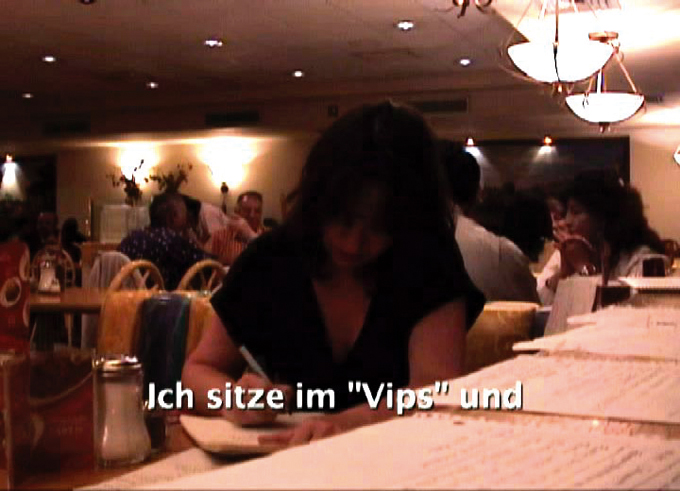
Künstlerbeitrag / Artist feature in Camera Austria International 88/2004, S. / pp. 10–21.
Aleksandra Mir, Stills aus / from: Organized Movement, 2004. Video, 55 min. -
ALEKSANDRA MIR

Künstlerbeitrag / Artist feature in Camera Austria International 88/2004, S. / pp. 10–21.
Aleksandra Mir, Stills aus / from: Organized Movement, 2004. Video, 55 min. -
ALEKSANDRA MIR

Künstlerbeitrag / Artist feature in Camera Austria International 88/2004, S. / pp. 10–21.
Aleksandra Mir, Stills aus / from: Organized Movement, 2004. Video, 55 min. -
ALEKSANDRA MIR

Künstlerbeitrag / Artist feature in Camera Austria International 88/2004, S. / pp. 10–21.
Aleksandra Mir, Stills aus / from: Organized Movement, 2004. Video, 55 min.
-
-
Newcomers to the Society of Spectacle
In the USSR, where unique works of art were seen, condescendingly, as something which “did not make it” into being reproduced, it was photography, film, posters and postcard reproductions which were rated high and auratic art. Even if painters oriented to the unique were sometimes making better deals with the state and earning more than book designers or photographers, it did not mean the painting as such was considered higher art: in the USSR, importance was not always directly expressed in paychecks. The State kept paintings in museums for the same reason it was taking away negatives from newspaper reporters: to have a monopoly on reproduction and distribution. This creativity producing a non-stop flow of images – be it photographs, paintings, or film shots – was opposed to capitalist professional art engendering isolated and undemocratic masterpieces. Communist images had to be devoid of qualities, of obvious technique which would define them as separate art objects, i.e. a potential commodity.
As a result of this system, a post-communist artist, appearing on the international capitalist market, had to resolve this flow-versus-masterpiece-problem, to isolate a separate image. It was not an obvious thing to do, since, in Russia, the image is still not completely isolated – the system survives to a certain extent. Even if the Soviet system was connected to the state propaganda market, which replaced a private market of physical things, it ended up being not as unique as it believed. Leaving an expiring communist civilisation at the end of the 1980s, Russian artists noticed that this system was functioning in the West as well, as a system of mass-distributed images. The incredible recent rise of the media market, especially the glamour media market, in post-Soviet Russia pushed many artists and especially photographers in this direction, offering them lucrative jobs. But there are still others who choose, at least partly, the way of institutionalised contemporary art, exhibiting in galleries and curatorial projects. For them, questioning both their own background of inflational creativity and the capitalist culture of art, i.e. pure spectacle, means introducing a breaking point into the image itself: a society in transition can only be expressed by an image in transition. Changing the point of view from that of a non-alienated and non-alienating friend to that of the consumer can hardly be anything but tragic – except for those cases where it is strangely comical.
Text feature in Camera Austria International 88/2004, pp. 22–32.
-
-
Newcomers to the Society of Spectacle

Künstlerbeitrag / Artist feature in Camera Austria International 88/2004, S. / pp. 22–32.
Sergej Bratkov, Sasha, aus der Serie / form the series: Kids, 2000. -
Newcomers to the Society of Spectacle

Künstlerbeitrag / Artist feature in Camera Austria International 88/2004, S. / pp. 22–32
Doppelseite / spread: Sergej Bratkov, S. / pp. 28–29. -
Newcomers to the Society of Spectacle

Künstlerbeitrag / Artist feature in Camera Austria International 88/2004, S. / pp. 22–32.
AES+F, Le Roi des Aulnes # 7, aus dem Zyklus / from the cycle: The King of the Forest, 2001. -
Newcomers to the Society of Spectacle

Künstlerbeitrag / Artist feature in Camera Austria International 88/2004, S. / pp. 22–32.
Igor Muchin, aus der Serie / from the series: Mädchen, Cita 2001. -
Newcomers to the Society of Spectacle

Künstlerbeitrag / Artist feature in Camera Austria International 88/2004, S. / pp. 22–32.
Boris Michailov, aus der Serie / from the series: U Zemli (Am Boden), 1991.
-
-
Carlos Aires: Dark Tales from the Dark Room
With his series “Snow White”, “Cinderella”, “The Three Pigs”, “The Enchanted Woods” etc., Carlos Aires, the thirty-year-old Spanish photographer, can be identified as using allegorical procedures in the field of photography. In these series which are unequivocally clear in their relation between the titles and the contents of the works (except “The Enchanted Woods”), we witness a constant return of absurd and paradox elements. And although Aires recently dropped the titles and now exhibits the works under the common denominator of “Happily Ever After”, the original titles established a direct connection to fairytales and their contents.
In “Snow White”, for example, the portrait of a black beauty functions as a threat to Western fairytales rooted in racialised and hegemonised narratives, and, what is even more, makes them obsolete. What is at work in Carlos Aires’ photographs is a contradictio in adjecto – he contests First World colonial mythologies with real bodies; real dwarfs take the stage in the photographs of the »Snow White« series. We see an approach that tries to transpose to our times what can be perceived as the past’s colonial ontology of fairytales.
In reference to Carlos Aires’ 2004 solo show at the Galerie Kusseneers in Antwerp, Stef Van Bellingen wrote: “In principle the characters in the photos play no other role than they do in everyday life. – With such artists as Velà zquez, Ribera, Goya and other masters, Spanish art has a long tradition of depicting dwarfs. It is possibly the only national school of painting that takes the dwarf seriously. The recent direction taken by the work of Carlos Aires is now characterised for the first time by drawing inspiration from Iberian culture. Yet this seems no more than an occasion to approach knowledge, information, image and reality as a staged construction. The artist?s area of interest lies in the complex relationship between the narrative strategy of the fairytale and reality as represented by the media and government bodies. On closer examination it becomes harder to maintain that our reality remains safeguarded from a fairytale morphology.”Text feature in Camera Austria International 88/2004, pp. 33–44.
-
-
CARLOS AIRES

Künstlerbeitrag / Artist feature in Camera Austria International 88/2004, S. / pp. 33–44.
Carlos Aires, Stills aus / from: Mister Hyde III (Meeting Room), 2003. Video und / and Soundinstallation, 6 min., looped. -
CARLOS AIRES

Künstlerbeitrag / Artist feature in Camera Austria International 88/2004, S. / pp. 33–44.
Carlos Aires, aus der Serie / from the series: Happily Ever After (Bullfighter 4), 2004. -
CARLOS AIRES

Künstlerbeitrag / Artist feature in Camera Austria International 88/2004, S. / pp. 33–44.
Carlos Aires, aus der Serie / from the series: Happily Ever After (Nuns), 2004. -
CARLOS AIRES

Künstlerbeitrag / Artist feature in Camera Austria International 88/2004, S. / pp. 33–44.
Carlos Aires, aus der Serie / from the series: Happily Ever After (Butcher), 2004. -
CARLOS AIRES
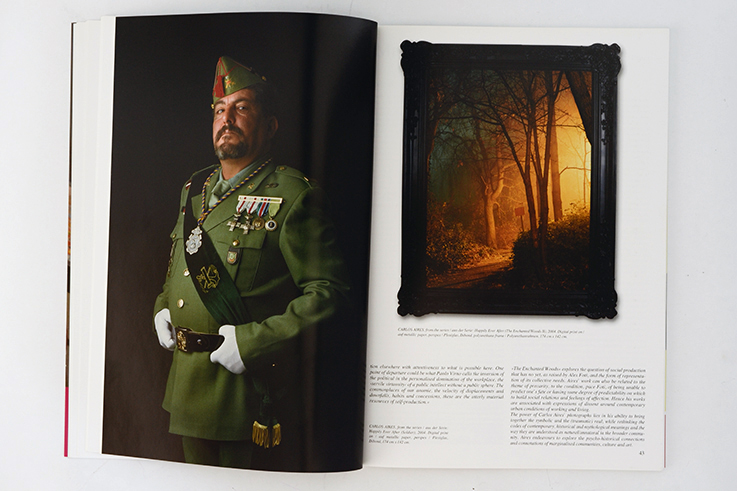
Künstlerbeitrag / Artist feature in Camera Austria International 88/2004, S. / pp. 33–44.
Doppelseite / spread: Carlos Aires, S. / pp. 42–43.
-
-
Markus Schinwald: Images as Experimental Set-Ups
The body is an incessantly actualized place at which the subject is constituted both in its identity and its instability and transversality. “The fact that subjectivity and world reflect each other, and indeed thereby establish themselves, is hence not a characteristic feature of our epoch. What is specific to our epoch are the conditions under which this takes place: the representational logic that determines our view of objects and the form that we assume ourselves, and the value that a visual field that is now organised with greater complexity attaches to these representations. It may sound surprising, but it is [photography] that has the greatest influence on how we live (and experience) this being mirrored.”
At any rate, Markus Schinwald’s works seem to take up and raise, to actualize and, above all, to contextualise these complexes of subjects pertaining to the body as a cultural construct. From the “Sneakers”, “Low Heels” and “Flatfooters” (1998), to “Dictio Pii” (2001) and the “Contortionists” (2003), to the film “1st Part Conditional” (2004), the obsession is manifested in all things related to the body as a materiality of the individual and the psychological. On the one hand, these are projects concerning fashion, sculptural reworkings of fashion consumer products, above all shoes, and film works on the other – the unwearability of the fashion and the, in some cases, bizarre movements of the bodies in the films seem to indicate a fundamental disorder. This disorder is characteristic of the individuals and of the objects: in one case it is the dysfunctional set pieces of fashion (shoes with no heels or a heel strapped around the ankle), that compel the potential wearers to perform practically impossible postures and movements; on the other hand, the autistic rituals of the film protagonist vis-à -vis the other, that appears unattainable, that indicate this disorder.Text feature in Camera Austria International 88/2004, pp. 45–55.
-
-
MARKUS SCHINWALD

Künstlerbeitrag / Artist feature in Camera Austria International 88/2004, S. / pp. 45–55.
Markus Schinwald, O.T., 2002, Öldruck. -
MARKUS SCHINWALD
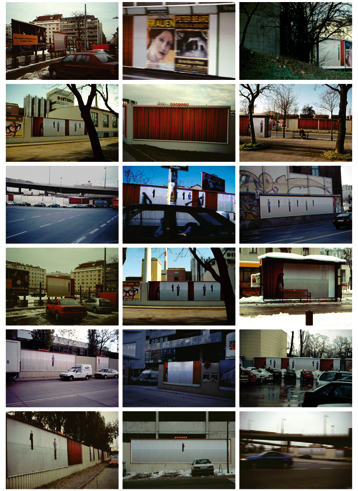
Künstlerbeitrag / Artist feature in Camera Austria International 88/2004, S. / pp. 45–55.
Markus Schinwald, Stage, 2000. 2500 Plakate. -
MARKUS SCHINWALD

Künstlerbeitrag / Artist feature in Camera Austria International 88/2004, S. / pp. 45–55.
Markus Schinwald, Contortionists (Vicky), 2003. -
MARKUS SCHINWALD

Künstlerbeitrag / Artist feature in Camera Austria International 88/2004, S. / pp. 45–55.
Markus Schinwald, O.T. (Legs), Fensterfolie, 2004. Installation: Frankfurter Kunstverein, Frankfurt. -
MARKUS SCHINWALD

Künstlerbeitrag / Artist feature in Camera Austria International 88/2004, S. / pp. 45–55.
Doppelseite / spread: Markus Schinwald, S. / pp. 50–51.
-
-
Mass-Media Acts (1)
On Visual Programming of the Political Space: Photo-Op Effects
One of the most widely published photographs in 2003 is of a beaming George W. Bush wearing a greyish-blue army workout jacket and surrounded by soldiers, cradling a roast turkey on a silver platter. The photo was taken by Anja Niedringhaus, a busy pool photographer in war zones and at sports events. Niedringhaus was one of the select few photo reporters who were allowed on site in the early morning of November 27, 2003, when the US president made a »surprise visit« to members of the 1st Armored Division, the 2nd ACR and the 82nd Airborne, who had been got out of bed especially for this occasion, in a hangar at Baghdad airport – bringing turkey, for breakfast.
The message of the picture is easy to understand: the president and commander-in-chief makes a point of leaving behind his own family in Texas on Thanksgiving in order to visit forces expecting a bit of homely warmth and affection while fighting thousands of miles away on the precarious front against rebels in Iraq. Although Bush only stayed on the ground for two and half hours to carry out his statesman’s duty of care, this brevity did nothing to diminish the success of his propaganda trip.
Immediately after this lightning media-military operation became known and the first photos and TV pictures were published, Bush?s survey ratings began to rise. Nothing was left to chance in order to achieve this effect. The production of this photo op, photo opportunity, as clandestine as it was highly official, had been performed under strict secrecy. Press officials had taken a small circle of unprepared journalists on board the president’s plane to witness the event.
The prime aim of Bush’s first visit to the front was to present to the public unambiguous pictures of a commander-in-chief standing by his forces in hard times. The fact that almost everything about Niedringhaus’s turkey picture, that gained the greatest currency of all photos taken at this press shoot, was »false«, initially did not detract from this purpose. By the time the Washington Post revealed that the dressed turkey the president is holding was actually not fit to eat (the soldiers were just being served from cafeteria-style steam trays when the president came in with his entourage and supposedly spontaneously picked up the silver platter with the decoration bird that just happened to be lying around somewhere), the opinion poll success had already long been notched up.Text feature in Camera Austria International 88/2004, pp. 72–73.
Forum
URSULA PALETTA
MIRIAM SCHÄNKE
ANDREAS HAGENBACH
SILVIA MICHELI
BERNADETTE FELBER
JOHANNES SEYERLEIN
DANNY TREACY
ATSUKO NAGANUMA
Exhibitions
The Future Has a Silver Lining. Genealogies of Glamour
Migros Museum, Zürich
DANIEL BAUMANN
Josef Kramhöller
Kunstverein, Düsseldorf
HANS-JÜRGEN HAFNER
Aktuelle Ausstellungen in Wien
NINA SCHEDLMAYER
Call Me Istanbul ist mein Name / Berlin – Istanbul. Vice Versa
KRYSTIAN WOZNICKI
1. Lodz Biennale
NINA SCHEDLMAYER
Alternatives Krisenmanagement. Steirischer herbst 2004
LUISA ZIAJA
Baudrillard und die Künste. Eine Hommage zu seinem 75. Geburtstag
GISLIND NABAKOWSKI
Inconvenient Evidence: Iraqui Prison Photographs from Abu Ghraib
CARLO MCCORMICK
Morgen ist auch noch ein Tag. Utopia Station
Haus der Kunst, München
HIAS WRBA
Robert Smithson
Museum of Contemporary Art, Los Angeles
SANDRA WAGNER
Peter Weibel: Das offene Werk 1964 – 1979
Neue Galerie am Landesmuseum Joanneum, Graz
MAREN LÜBBKE-TIDOW
Printemps de Septembre 2004. Rendez-vous des images contemporaines
Toulouse
JÖRG BADER
Ciny Sherman: Clowns
Kestnergesellschaft, Hannover
KERSTIN BRANDES
Double Exposure. William Eggleston & Wilmar Koenig
NBK, Berlin
CAROLIN FÖRSTER
Saskia Olde Wolbers
Interim Art, London
ROY EXLEY
Books
Fehler der Fotografie. Clément Chéroux: Fautographie
Editions Yellow Now, Crisné
HERTA WOLF
Carmela Garcia: Women, Love & Lies
Colleccion Foto, Madrid
SALLY STEIN
Imprint
Publisher: Manfred Willmann. Owner: Verein CAMERA AUSTRIA, Labor für Fotografie und Theorie
All: Lendkai 1, A-8020 Graz
Editors Graz: Reinhard Braun, Christine Frisinghelli, Manisha Jothady
Editor Berlin: Maren Lübbke-Tidow
Copy editing: Marie Röbl
Translations: Wilfried Prantner, Richard Watts