
Camera Austria International
87 | 2004
- SØNKE GAU
Aglaia Konrad: Floating Images - AGLAIA KONRAD
- MAREN LÜBBKE-TIDOW
Hans Schabus: Re-presentations - HANS SCHABUS
- JAN VERWOERT
The New History of Ideas Without Future - NINA SCHEDLMAYER
on Sabina Hörtner - SABINE HÖRTNER
- SIEGFRIED ZIELINSKI
Conversation between Heinz Emigholz and Siegfried Zielinski
- HEINZ EMIGHOLZ

Preface
This issue of Camera Austria provides an insight into the work of artists whom we have been observing for some time, documenting their positions in our magazine at a very early stage or presenting them at our exhibitions. In 1999, for instance, we invited Hans Schabus to present his works together with Gottfried Bechtold in our former exhibition rooms. This presentation was followed by a first extensive contribution in issue No. 68 of our magazine. Meanwhile Hans Schabus has not only taken part in numerous group exhibitions such as the Manifesta in Frankfurt (2002), but has also been invited to solo exhibitions in major institutional contexts such as the Secession, Vienna, the Bonner Kunstverein (both 2003), or, soon, at Kunsthaus Bregenz – reason enough for us to present a selection of his latest works. The pictures we are showing were taken during a trip through Poland in July 2004.
Entries
-
Aglaia Konrad: Floating Images
Aglaia Konrad distances herself from a model of architectural photography that is primarily iconographical and formalistic both through the selection of what she depicts and through the formal reproduction of what she photographs. Contrary to the conventional representative urban views, she is interested not in the landmarks or typical urban scenarios, but rather the urban outskirts: the periphery, the urban infrastructure, building sites and generally unfamiliar buildings. In her work, and independent of their functions and context, these buildings exhibit a certain unspectacular uniformity of design, whose vocabulary of form can be seen as a symbol of modernism.
Aglaia Konrad’s works refer to the promises of modernism and their concrete implementation – the discrepancy between utopia and utilitarianism in the realm of architecture and urban planning. Aglaia Konrad’s stance towards modernism, however, is not emphatically critical. We see a balance between fascination with the architectural and urban-planning ideas of modernism and attention to the collateral damage caused by the fundamental changes due to processes of globalisation. Her pictures from numerous cities around the world evidence the fact that modernism is a global system that eludes definition by rigid boundaries. The photographs are either untitled or the titles are restricted to place names and years. Viewed as a whole, they generate a global picture of the urban sphere with remaining local references that nevertheless do not denote any actual place, nor do they reveal any comprehensible pattern of ordering at first glance. As in the fairy-tale of the hare and the tortoise, no matter where in the world Aglaia Konrad travels, modernism is already there. The artist succeeds in drafting an alternative form of cartography that, unlike the geographical map, that is based on a phenomenological conception of space, depicts structures that may no longer be read as a space-time continuum in view of their splitting. Linear structures with fixed points of reference have been replaced by a rhizomatic movement. The constellation of time-shift and placelessness detaches the photographs from the context of documentation and lends them a fictional, narrative component.Text feature in Camera Austria International 87/2004, pp. 7–18.
-
-
AGLAIA KONRAD

Künstlerbeitrag / Artist feature in Camera Austria International 87/2004, S. / pp. 7–18.
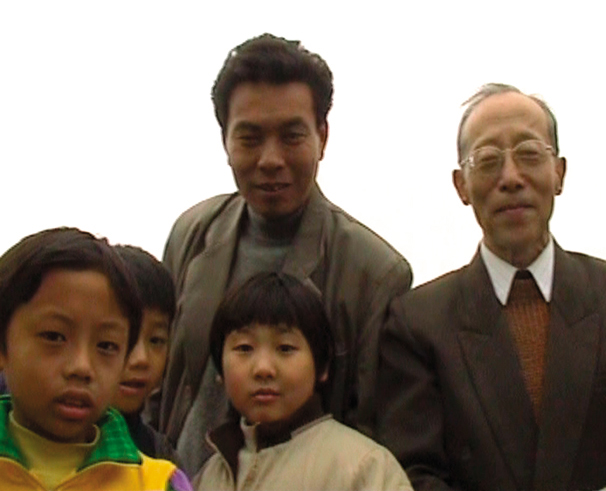
Aglaia Konrad, Video Stills aus / from: Tomorrow Square, 2004. -
AGLAIA KONRAD

Künstlerbeitrag / Artist feature in Camera Austria International 87/2004, S. / pp. 7–18.
Doppelseite / spread: Aglaia Konrad, S. / pp. 12–13. -
AGLAIA KONRAD
Künstlerbeitrag / Artist feature in Camera Austria International 87/2004, S. / pp. 7–18.
Aglaia Konrad, Video Stills aus / from: Tomorrow Square, 2004. -
AGLAIA KONRAD

Künstlerbeitrag / Artist feature in Camera Austria International 87/2004, S. / pp. 7–18.
Aglaia Konrad, Video Stills aus / from: Tomorrow Square, 2004. -
AGLAIA KONRAD

Künstlerbeitrag / Artist feature in Camera Austria International 87/2004, S. / pp. 7–18.
Aglaia Konrad, Video Stills aus / from: Tomorrow Square, 2004. -
AGLAIA KONRAD

Künstlerbeitrag / Artist feature in Camera Austria International 87/2004, S. / pp. 7–18.
Aglaia Konrad, KOPIE / CITY, Graz 2004.
Installation: Camera Austria, Graz 2004.
Photo: Manfred Willmann.
-
-
Hans Schabus: Re-presentations
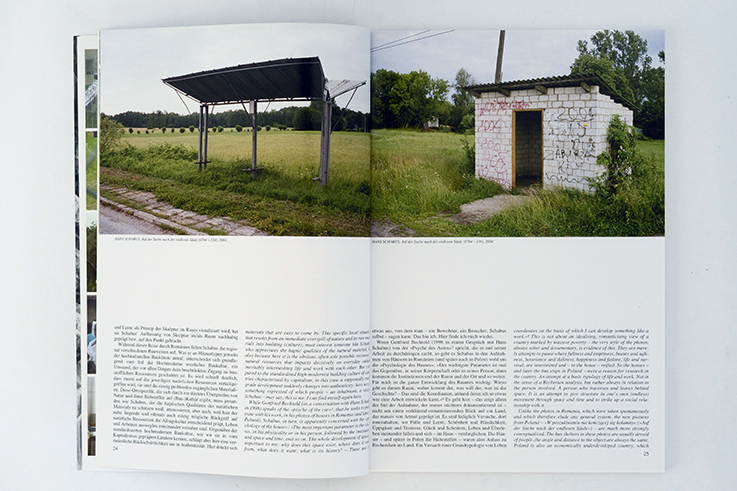
The photographs that Hans Schabus has been adding to the complex of works “Auf der Suche nach der endlosen Säule” since 2003, on the other hand, are more akin to an (in)complete and incompletable report. The photos of bus stops taken on a trip to Poland in July 2004, some of which are featured in this issue, were also added to this collection of pictures. A journey through Romania last year, which ended with a visit to the Brancusi monument, marked the beginning of an effort to systematize different photographic documents that he had created so far and that he is now creating with “Auf der Suche nach der endlosen Säule”. Unlike other artists, Schabus does not quote Brancusi’s “Endless Column” as form, never showing it directly, the reference in the title of his complex of works “Auf der Suche nach der endlosen Säule” does, however, demonstrate his awareness of the fact that, with the column that may be endlessly extended and conceptually elongated up and down, Brancusi transcended certain dimensions as it put an unprecedented focus on a fundamental problem of sculptural work. With its reproducible, stereometric basic elements, which are used to visualise the interplay of matter and emptiness as a principle of sculpture in space, it impacted profoundly on and pinpointed Schabus’ conception of sculpture in / as space.
During this journey through Romania, Schabus noticed the different regional building methods. The variety of house types beyond the realm of high-culture architecture that he encountered differed fundamentally from the high-modernist style of western culture, a fact that is above all due to the restricted availability of building material resources. It soon becomes clear that people first make use of the various natural resources, as they are the only materials that are easy to come by. This specific local situation, that results from an immediate overspill of nature and its raw materials into building (culture), must interest someone like Schabus, who appreciates the haptic qualities of the natural material, but also because here it is the obvious, often sole possible recourse to natural resources that impacts decisively on everyday culture, inevitably intermeshing life and work with each other. But compared to the standardised high-modernist building culture of countries characterised by capitalism, in this case a supposedly retrograde development suddenly changes into authenticity: here we see something expressed of which people “an inhabitant, a visitor, Schabus“ may say, this is me. I can find myself again here.Text feature in Camera Austria International 87/2004, pp. 19–30.
-
-
HANS SCHABUS

Künstlerbeitrag / Artist feature in Camera Austria International 87/2004, S. / pp. 19–30.
Hans Schabus, Auf der Suche nach der endlosen Säule (0704 - 136), 2004. -
HANS SCHABUS

Künstlerbeitrag / Artist feature in Camera Austria International 87/2004, S. / pp. 19–30.
Hans Schabus, Auf der Suche nach der endlosen Säule (0704 - 186), 2004. -
HANS SCHABUS

Künstlerbeitrag / Artist feature in Camera Austria International 87/2004, S. / pp. 19–30.
Hans Schabus, Auf der Suche nach der endlosen Säule (0704 - 140), 2004. -
HANS SCHABUS

Künstlerbeitrag / Artist feature in Camera Austria International 87/2004, S. / pp. 19–30.
Hans Schabus, Auf der Suche nach der endlosen Säule (0704 - 1123), 2004. -
HANS SCHABUS

Künstlerbeitrag / Artist feature in Camera Austria International 87/2004, S. / pp. 19–30.
Hans Schabus, Auf der Suche nach der endlosen Säule (0704 - 124), 2004. -
HANS SCHABUS
Künstlerbeitrag / Artist feature in Camera Austria International 87/2004, S. / pp. 19–30.
Doppelseite / spread: Hans Schabus, S. / pp. 24–25.
-
-
-
The New History of Ideas Without Future
Künstlerbeitrag / Artist feature in Camera Austria 87/2004, Seite / Page 31-38.
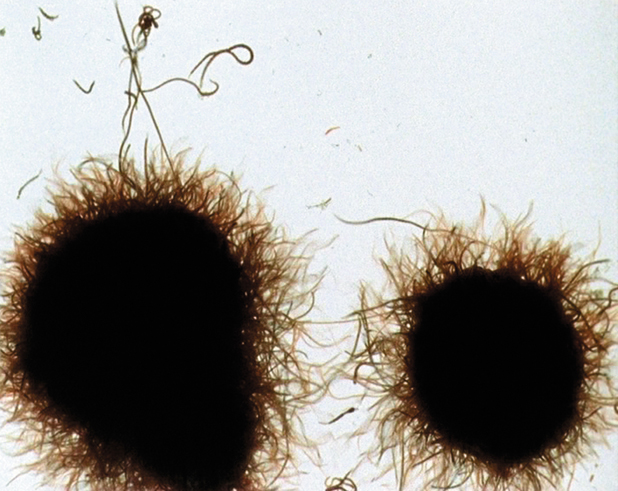
FLORIAN PUMHÖSL, Still aus / from: O.T., 2003, 29 min., loop. -
The New History of Ideas Without Future

Doppelseite / spread: Marko Lulic, Paulina Olowska, Jane & Louise Wilson, S. / pp. 34–35.
-
-
on Sabina Hörtner
Rarely has anyone defined the relation between the spectator and the eye as radically as Sabina Hörtner in her work “07/13–04”, that she installed in February/March 2004 for the exhibition “Der Widerstand der Fotografie” (The Resistance of Photography) in the corridor between the Kunsthaus Graz building and the Camera Austria exhibition room. The passage, lined in white with the exception of one strip left uncovered, resembles a boarding ramp. On the darker strip, that ran through the whole passageway, a very bright rectangle of light moved in a constant rhythm from the bottom to the top – i.e. towards the visitors walking in. The fast movement was more like a “whizzing up”, accompanied by the noise of the light source, a scanner. The visitors could choose whether to enter the »spotlight« or, once again, leave this to art – i.e. whether or not the separation of spectator and eye is cancelled out. If Sabina Hörtner’s works emphasise spatial linearity they also do so with a linear axis of time – as expressed here in the titles of the works, that designate the duration of their presentation and, thus, of their existence. At specific, random points, the photographic documentation picks out certain moments on a time-line – inevitably so, as the works are temporary and uncontrollable and thus irreversible and unrepeatable. The artist cannot control what drawings the laser pointers create, what signals the floodlights generate, as these are solely the result of coincidence or weather conditions – as are the photographic images that ultimately remain. Coincidence was also the director in an older work that Hörtner installed at Salzburg’s Rupertinum: jerkily and randomly moving sprinkler systems held laser pointers that drew patterns on the wall – a setting for random, uncontrollable production of visual phenomena. That which appears is not necessarily relevant. But rather the fact that.
Text feature in Camera Austria International 87/2004, pp. 39–44.
-
-
SABINE HÖRTNER

Künstlerbeitrag / Artist feature in Camera Austria International 87/2004, S. / pp. 39–44.
Sabina Hörtner, Up to the Stars, 2004.
Installation: Medienturm Graz. -
SABINE HÖRTNER

Künstlerbeitrag / Artist feature in Camera Austria International 87/2004, S. / pp. 39–44.
Sabina Hörtner, Up to the Stars, 2004.
Installation: Medienturm Graz. -
SABINE HÖRTNER

Künstlerbeitrag / Artist feature in Camera Austria International 87/2004, S. / pp. 39–44.
Sabina Hörtner, 07/13-04, 2004.
Installation: Camera Austria, Graz. -
SABINE HÖRTNER

Künstlerbeitrag / Artist feature in Camera Austria International 87/2004, S. / pp. 39–44.
Sabina Hörtner, 07/13-04, 2004.
Installation: Camera Austria, Graz. -
SABINE HÖRTNER

Künstlerbeitrag / Artist feature in Camera Austria International 87/2004, S. / pp. 39–44.
Sabina Hörtner, 07/13-04, 2004.
Installation: Camera Austria, Graz. -
SABINE HÖRTNER

Künstlerbeitrag / Artist feature in Camera Austria International 87/2004, S. / pp. 39–44.
Doppelseite / spread: Sabina Hörtner, S. / pp. 40–41.
-
-
Conversation between Heinz Emigholz and Siegfried Zielinski
Siegfried Zielinski: “Photography and beyond” displays its effect on two levels, on the level of the individual film you insert in your project, but also as a work about a film-visual and audio-visual archive. What successively emerges is an encyclopaedia of the means with which very individual architects have accentuated, changed and transformed places.
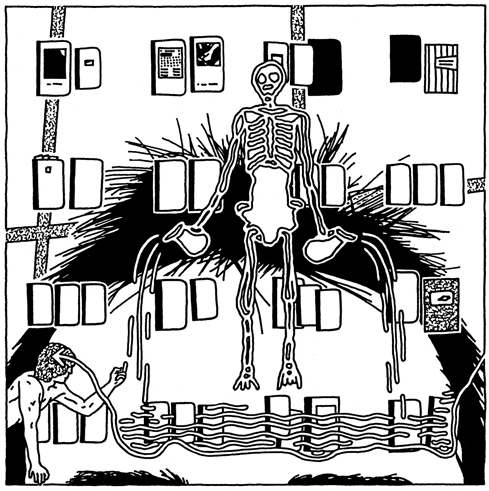
Heinz Emigholz: Liberated of allocations of meaning, things can speak for themselves again. Film can go back to just showing, and must allow itself to be measured by what it portrays and how it does so. In the group entitled “Architecture as Autobiography” I show something that was almost criminally stifled by the “International Style” and “Bauhaus” movement. Like Rudolph Schindler, Bruce Goff was deliberately marginalised and edged out. Just because they were not ideologists who wanted to operate around the globe but rather felt committed to the specific places and the specific forms of their buildings. Now, film – as a monument – has the power to focus attention on these buildings in such a way that they can no longer be argued away. However, I can only assert the “archive” idea, which is an encyclopaedic idea, in my own productions. In the subgroup “The Basis of Make-Up”, I present all my notebooks, sketchbooks and drawings with allocations that make most sense. It is complete in itself but it is also a parody on the encyclopaedia. Its goals go beyond the individual. Personal aspects only interfere within its sphere, and I focus intimately on this interference.
S. Z.: Is that a task that you assign to photographic film after it has passed through the electronic acceleration and cleaning machinery? The permanent conservation of (building) aesthetic sensations and of the artist?s respectful view of them? Cinema, perhaps, as a museum in the best sense of the word, as a place of refining – in this case – built fantasies?
H. E.: I can only offer what I do best: representing space in two dimensions. I see myself as a camera person tolerated by virtue of a contract with humanity, as someone who provides viewing results. That is no more and no less than a utopia without dramaturgy. In view of all the things media are now capable of, it is something like a second paradigm shift. The aim is no longer to cover and interpret reality with language, but rather “only” to show it as perfectly as possible with the aid of an intact photographic surface in the sense of “presentation” – a motive as old as the history of film, but long buried in a side-line: to recognise the reality of surfaces as a logical system, without being in search of an “inner” code – a search that has so far turned all intellectuals into criminals.
Text feature in Camera Austria International 87/2004, pp. 46–57.
-
-
HEINZ EMIGHOLZ

Künstlerbeitrag / Artist feature in Camera Austria International 87/2004, S. / pp. 46–57.
Heinz Emigholz, Fotografische Skizzen zu "Tale of Five Cities". -
HEINZ EMIGHOLZ

Künstlerbeitrag / Artist feature in Camera Austria International 87/2004, S. / pp. 46–57.
Heinz Emigholz, 5 Zeichnungen aus der Serie "Die Basis des Make-Up", 1974 - 2004. -
HEINZ EMIGHOLZ
Künstlerbeitrag / Artist feature in Camera Austria International 87/2004, S. / pp. 46–57.
Heinz Emigholz, 5 Zeichnungen aus der Serie "Die Basis des Make-Up", 1974 - 2004. -
HEINZ EMIGHOLZ

Künstlerbeitrag / Artist feature in Camera Austria International 87/2004, S. / pp. 46–57.
Heinz Emigholz, 5 Zeichnungen aus der Serie "Die Basis des Make-Up", 1974 - 2004. -
HEINZ EMIGHOLZ

Künstlerbeitrag / Artist feature in Camera Austria International 87/2004, S. / pp. 46–57.
Heinz Emigholz, 5 Zeichnungen aus der Serie "Die Basis des Make-Up", 1974 - 2004. -
HEINZ EMIGHOLZ

Künstlerbeitrag / Artist feature in Camera Austria International 87/2004, S. / pp. 46–57.
Heinz Emigholz, 5 Zeichnungen aus der Serie "Die Basis des Make-Up", 1974 - 2004.
-
Forum
BRUNO SANTOS
HYNEK ALT
ALEXANDRA VAJD
CARLA AHLANDER
ELOISE CALANDRE
VANDA TEUTA VUCICEVIC
FRANZ SATTLER
CHRISTINA SKRABAL
MARYSE LARIVIERE
Exhibitions
No Unexplained Shadows. August Sander: People of the Twentieth Century
RACHEL BAUM
Barocke Träumereien. “Videodreams. Zwischen Cinematischen und Theatralischem”
Kunsthaus, Graz
ULRICH TRAGATSCHNIG
Aufhören, ohne am Ende zu sein. Kurze Karrieren”
MUMOK, Wien
FRIEDRICH TIETJEN
The last Picture Show. Artists Using Photography 1960 – 1982
Walker Art Center, Minneapolis u. a.
MANUEL OLVEIRA
Photoespana: Historias
VII. festival International de Fotografia y Artes Visuales
AMANDA CUESTA
Sommergruppenausstellung. Telepathy Curating
MAREN LÜBBKE-TIDOW
Artists’ Favourites
ICA Gallery, London
DENISE ROBINSON
Rodney Graham: A Little thought
Art Gallery of Ontario, Toronto u. a.
TERENCE DICK
Manifesta 5
MANUEL OLVEIRA
Wirklich wahr! Realitätsversprechen von Fotografien
Ruhrlandmuseum, Essen
JOHANNA DI BLASI
Heinrich Riebesehl: Fotografische Serien 1963 – 2001
CAROLIN FÖRSTER
John Waters: Change of Life
HANS-JÜRGEN HAFNER
Noch ist nichts zu sehen. Recherche – entdeckt! Bildarchive der Unsichtbarkeiten
6. Int. Fototriennale Esslingen
KERSTIN STREMMEL
Stéphane Couturier: Mutations
Bibliothèque national de France, Paris
ANNE BERTRAND
Books
Heinz Emigholz: Das schwarze Schamquadrat
MARC RIES
Stan Douglas: Every Building on 100 West Hastings
Arsenal Pulp Press, Vancouver
KELLY WOOD
Untitled (Experience of Place)
Koenig Books, London
MARINA GRZINIC
Diskurse der Fotografie
Suhrkamp. Frankfurt
KATHRIN PETERS
Imprint
Publisher: Manfred Willmann. Owner: Verein CAMERA AUSTRIA, Labor für Fotografie und Theorie
All: Lendkai 1, A-8020 Graz
Editors Graz: Reinhard Braun, Christine Frisinghelli, Manisha Jothady. Trainee: Margaretha Liebmann
Editor Berlin: Maren Lübbke-Tidow
Copy editing: Marie Röbl
Translations: Richard Watts